Showing posts with label role-playing. Show all posts

Thursday, November 15, 2012

Dungeon Mastering: What about the Details?

Every role-playing game provides rules for specifying different details. At its most intricate level, there are a vast quantity of role-playing details that could be tracked, from every item a character has in his or her pockets to the precise number of pounds a character can heft. What you track says a lot about what you want your game to focus on. Some people are surprised at what can be abstracted. Some people are amazed when I tell them that as both a player and DM I do not bother tracking treasure. The truth is that there are a lot of details that can be tracked or disregarded and how you address those types of details says a lot about the type of game you want to play.

Distances and Combat

One thing that comes to mind is the idea of distance as it relates to battle. Consider Dungeons & Dragons, Fourth Edition, where every distance is given in squares. This is relevant because combat is expected to be conducted on a battle map where each square is 5 feet by 5 feet. How far a creature can move, a weapon can be thrown, or a spell can be cast is extremely important on the tactical combat grid.

Contrast it with games like 13th Age or Warhammer Fantasy RolePlay (3rd Edition). In 13th Age, ranged weapons have very abstract notions of range, such as "Nearby Targets Only." Warhammer FRP takes a similar stance, dividing range into Close, Medium, Long, and Extreme. Neither of these games go to great lengths to specifically declare how far these distances are. As the 13th Age rulebook states, "Usually you move fast enough to get where you want to go in a battle." This is a sharp contrast to Dungeons & Dragons, a game that has always given explicit speeds for creatures and distances for ranged weapons. What games like 13th Age or Warhammer FRP do worry about, though, is whether two creatures are engaged with one another or not.

This is a heated combat in Warhammer FRP. I swear.
The different focus changes the way combat feels. In D&D 4E, combat involves a lot of counting of squares. Distance matters and positioning is important. To a certain extent, D&D 4E combat is like Final Fantasy Tactics: The War of the Lions or XCOM: Enemy Unknown. In games like Warhammer or 13th Age, the move to abstract distances changes the focus more on actions and less on how far somebody can move. Where people are in combat matters and has technical effects, but it is nowhere near as important as in a tactical game like 4E. Both systems have their place in the tabletop RPG world. What is important is that the game group decide which approach would be more appealing for them.

Money, Equipment, and Encumbrance

The D&D Equipment List, circa 1993.
(notice the lack of barrels of pickled fish)
As a player and Dungeon Master, I never realized how little I cared about tracking money, equipment, and other personal property until I spent some time running d20 Modern. d20 Modern gave every character a "Wealth bonus" that was a general representation of their overall wealth. Players did not track each individual dollar but instead had a sense that this character was middle-class, poor, or disturbingly wealthy. If a character wanted to buy an item, they made a corresponding wealth check to see if they had the means to purchase it. Purchasing especially expensive items could lower the character's wealth bonus while earning significant amounts of money could raise the wealth bonus.

As a (young) player who had grown up tracking wealth down to the copper piece, the idea that it could be abstracted was fascinating. For some reason, this had never come up before. This idea sat in my thought-space throughout the near-decade that I managed to avoid playing any tabletop RPGs. When I finally came back to D&D, my approach had changed considerably. Seeing the "adventurer's kit" appear in the equipment list seemed enough for me to decide that the odds and ends of equipment, like wealth, were generally not worth the time to track. We just assumed that unless it seemed interesting otherwise, the characters had the typical equipment that they needed. Who cares if your character has five torches or two, thirty arrows or sixty. What matters is whether you run out. From my experience, running out of equipment, be it rations or crossbow bolts, is something better decided by the table (both players and Dungeon Master) when it's interesting in the context of the narrative. I felt the same about encumbrance rules. If I did not intend to bother tracking the details of what players had, why would I care about the details of how much it weighed?

Right. Encumbrance rules are optional.
Of course, that is my perspective on equipment. There are many players for whom equipment and wealth, like any other details, are important elements of the game worth tracking. I have met a number of people that really enjoy that aspect of the game. How much you have, how much you can carry, and how much it matters can be an important (and interesting) element of gameplay that may potentially shape the direction of the campaign. Getting that huge pile of gold out of the dragon's lair is important; knowing how many trips with how many mules is an important part of the game. At least for some players, that is. The important point about equipment, gold, and encumbrance, as with distances in combat, is making sure everybody at the table cares about the same kinds of things.

Other Details

There are a lots of details to focus on in a tabletop role-playing game. Everything from mapping a dungeon to counting experience points is something that a game group may, or may not, consider important. Being able to recognize that different players are interested in different things is important in putting together and maintaining a game group. Hopefully, by realizing that almost every aspect of the game is a potentially unnecessary detail that is up for discussion, groups will more readily come together and stay together.

Saturday, August 4, 2012

The Elements of a Classy RPG: Dungeons & Dragons (Third Edition)


Dungeons & Dragons has had many versions, editions, supplements, variants, and novations through the years. One of the most important editions of the game came to the public eye in 2000, when Dungeons & Dragons Third Edition was first released. It came after the Second Edition had been around for eleven years, seeing countless product releases, rules supplements, adventure modules, campaign settings, and gaming detritus that still litter the shelves of second-hand bookstores across the country.  Where Second Edition maintained a lot of the core mechanics of the First Edition, Third Edition took a significant number of steps away from the recognized canon. Although a number of "sacred cows" were retained but many features, previously considered untouchable, were eliminated, evolved, or re-engineered into a new framework. The class system is one of the features that had notable changes worth discussing here.

Gimble is a Bard, not a Sorcerer/Thief.
You can tell because he has an instrument.
The Player's Handbook contained eleven classes. Most of the classes had been standard selections from the previous edition. A few classes, such as the Barbarian and Monk, had previously existed in some form or another but now made their debut as core classes. One class, the Sorcerer, was a new class intended to fill the growing desire by players for a non-Vancian (or, as I prefer, non-Gygaxian) spell-caster. However, the most novel feature about classes in the Third edition, and potentially the most important, was not their variety, selection, or number. It was the multi-classing rules that made Third Edition something to really think about and value as a game.

Third Edition characters have two concepts of level. Character level is the overall measure of the character's experience while class level is specific for each class and measures the character's training within that class. Whenever a character gains a level, the player chooses which class to level in, generally selectable from any class. So, if you make a half-orc Fighter at first level, you could very well choose to take a level of fighter, thief, or even wizard when you advance to level 2. For that matter, you could take a level in whichever class you wanted. Third Edition broke open the class system, allowing a player to make whatever choices they wanted regarding their character and his or her "class."  Of course, there are a few technical limitations. Generally, characters must keep all of their class levels within one level of each other or the character will incur (experience) penalties. That level 5 Ranger, level 2 Paladin, level 3 Wizard, level 8 Fighter you had always wanted to take on an adventure is a problem within the 3E framework because she'll get less experience and, thus, level up at a slower rate than her adventuring friends. But, barring that restriction (to which there are exceptions), the system lets you do what you want with your character.  Does Gronk the Fighter want to spend some time at the Wizard's Institute of Technocery? Grab a level of wizard!
Ember was upset to learn that she, as a
Monk, would be unable to multi-class.

It does not even stop there at that, though. Third Edition was the system for people that wanted a grotesque amount of character options. Beyond the initial eleven character classes, this version of D&D featured advanced classes that had some sort of prerequisite for entry. Called "Prestige Classes," these classes provided even greater abilities for characters that were able to take levels in the class. Prestige Classes were exciting because they provided a special suite of abilities, powers, and bonuses that catered nicely to a specific arrangement of class features. Wanted to make a fighter who used a bow and knew magic? The Arcane Archer provided bonuses and special abilities for that combination of talents, allowing the character to infuse his arrows with magical energies. Beyond the small number provided, the Prestige Class was an opportunity for Players and Dungeon Masters to create specific classes suited to the campaign setting or player concept that were limited in scope (maybe 5-10 levels worth of advancement) but that emphasized a certain synergy of abilities, powers, or features.

Although the first publication of D&D had few Prestige Class options, each supplement continued to add to the roster of available options, making the field of class options quite expansive. Later publications even included new base classes, further expanding the options for character advancement. Some characters were merely alternatives to existing classes, such as Fighter variants or Wizards of different schools. Some where entirely new classes readily injectable into the mighty multi-class morass that had developed. As a player, you had many choices to make at each level with regard to what class in which you wanted to advance. This was a role-playing ruleset where anything and everything seemed possible. Because of this freedom of character design, Third Edition earned a reputation as a player's game.

Considering the system laid out in the Third Edition, one may think that it should have been the definitive take on a class system as it provides numerous options and the freedom to do practically anything. But, there are a few peculiarities.
Alright, guys. Which of these multi-class option should I take?
One problem faced by the Third Edition system was the contrast of basic, wide-reaching classes to specific, narrowly-tailored classes. To illustrate, consider two brave adventurers, Bob and Tom. Bob and Tom are both level 4 humans. Bob is a level 2 fighter and level 2 cleric. Tom is a level 4 paladin. Both have some fighting prowess. Tom is strictly better at hitting than Bob but Bob has a few more options in combat from his fighting feats. Both have divine abilities, although they express their divine powers in different ways. Bob casts spells, choosing from an expansive list of Cleric spells, while Tom can sense evil, heal his allies, and gain bonuses against evil foes. But, as far as characters go, they are both... holy warriors? They both battle monsters and wield the forces of their god. The biggest difference is that Tom the Paladin has a more restricted set of abilities than Bob the Fighter/Cleric.

She's actually charting the requirements
for her next Prestige Class. It's complicated.
This clash highlights one of the dormant issues in the Third Edition system: What is the purpose of the Paladin, a specialized Holy Warrior, in a game with free multi-classing rules that allow a Fighter/Cleric Holy Warrior with little to no fuss? The ungainly restrictions attached to the Paladin make it even stranger: Why can only Lawful Good gods have Paladins? Is there something inherently Lawful Good about detecting evil? My Fighter/Cleric can do it, except that he does it as a spell. There are other examples of the peculiarity, such as with the sorcerer/thief and the bard (different shades of the magical trickster), but the Paladin and Fighter/Cleric represent the most obvious example.

In a system like Rifts, where each class told you how you fit into the world, D&D Third Edition almost feels like it does quite the opposite as it provides different ways to make the same character concept but with different mechanical outcomes. Want to be a dashing duelist? Maybe you could make a Fighter/Rogue character. Maybe just a Rogue. Or, perhaps a Swashbuckler? Swashbuckler/Rogue? A Fighter/Swashbuckler/Rogue? The system seems to get strangest when mixing basic, broad classes like the Fighter or Wizard with very specific, specialized classes like the Paladin or Bard. One begins to wonder what it means to be a Fighter/Ranger/Paladin character. Technically, these feel like they should all be same shades of the same basic character, but within the Third Edition framework, they are distinct classes to be chosen when leveling up a character.

After playing Third Edition for a brief period, I started to think that that all I really needed were the four "basic" classes (Fighter, Wizard, Cleric, and Thief) and cleverly designed Prestige Classes.  The rest would be composed of some combination of those classes, maybe throwing in some specific Prestige Class along the way. Unfortunately, although the four basic classes covered a lot of ground, it is clear that they leave a vast array of potential character ideas out. Eventually, I began to hypothesize that what the game really needed was a solid array of basic classes that naturally developed into more specialized, advanced classes attainable after a few levels of dabbling in the core classes. Interestingly, that would later be done within the same d20 System framework in the d20 Modern Roleplaying Game, but that is a discussion for another time.

Krusk later regretted that level of
Librarian he took early in his career.
Another peculiar feature of Third Edition's class system was that, with such an abundance of options, it was quite easy to make bad choices. In fact, it was probably far easier to make a bad choice than a good one.  It is quite simple to realize several levels down the line that grabbing that level of Ranger early in the campaign was a terrible mistake. Or taking that Toughness Feat. While some choices may simply be situationally poor (such as taking Magic Item creation feats in a game where there are no Magic Items), others are simply not meant to be chosen together. It is strange that a game in which one would expect to play the same character for months, even years, would have a rule system in which bad choices are not only possible, but likely, and that no method to rectify bad choices exist. For players that hoped to do more than just play the pickup game at their local convention, Third Edition seemed to have it against you.

Unfortunately, for a system filled with a plethora of rules for different situations, it was not until Player's Handbook II that 3.5 addressed the idea of retraining. Granted, I would imagine any DM would allow players who realize they had made catastrophic mistakes with their character to have a go at re-building the character, but the idea that it took years of supplements to formalize it in the ruleset was peculiar, to say the least.

Some of the more obvious peculiar expressions of the Third Edition multi-class system came about in the d20 Star Wars RPG. Based on a very similar version of the d20 ruleset presented in Dungeons & Dragons Third Edition, the Star Wars RPG took the game to a long time ago in a galaxy far, far away. Game books would always feature stat blocks for iconic characters. As new source books were released with new Prestige Classes, feats, and features, some iconic characters would change class or build to better suit the new content. The Dark Side Sourcebook includes a stat block for Emperor Palpatine that included the following text:
The statistics presented here differ from those presented in the Star Wars Roleplaying Game.While these statistics provide a much more holistic interpretation of the Emperor's abilities, either version of the Emperor works perfectly well for most roleplaying purposes.
I have multiple, different stat blocks, young Skywalker,
but I'll happily electrify your ass with any one of them.
Although there is nothing inherently wrong with having to adjust, even ret-con, the occasional stat block, the idea that even the villains needed a few chances to "get it right" said something about the potential complexity of the system. I could almost here the player upset on discovering that an important boss has multiple game statistics. "But, last week he couldn't do that!"

This was even more apparent with the "power creep" that often appears in Dungeons & Dragons. Later content, such as classes and monsters, would be more powerful than earlier classes. Sometimes done to "balance things out" while other times done just to make new features interesting, the net result was that things introduced later would have a higher power level than earlier options. This could lead to new features, feats, or Prestige Classes meant to balance out the problems. The net result was a slow escalation, leaving early sourcebook options relatively unimpressive in later years. "Oh, you're a standard Fighter? I'm glad you think that still works for you!" Eventually, the iconic heroes and villains featured in early sourcebooks would have to be replaced by a more powerful version to keep up. It is no wonder that only four or so years into the game they felt the need to release an updated rulebook, version 3.5, to blank the slate.

The Third Edition of Dungeons & Dragons brought a lot of interesting ideas to the table, at least with respect to the Dungeons & Dragons game. A more flexible and robust system let players make characters that felt more like the character they wanted while giving them unique or interesting abilities to distinguish them from every other character out there. Unfortunately, having too many options or unnecessarily repetitious options weakened the impact of the system. Overly specific character classes did not mesh well with extremely general ones, leading to peculiar results. Further, having identifiably bad options or, in the worse case, secretly bad options, undermined the strengths of the system. Finally, the slow progression in supplements of raising the power level tended to make earlier options less impressive, sometimes even relegating them to obscurity. In the end, it opened a lot of interesting doors in the world of Dungeons & Dragons and class-based RPG systems, but it leaves open a lot of strangeness that should really have been better resolved.

Wednesday, July 11, 2012

Dungeons & Dragons and Star Wars

As I put the finishing touches on my eleventh or twelfth Star Wars themed Dungeons & Dragons character, I thought I would take time to say a few things about how Dungeons & Dragons (4th Edition) and Star Wars intersect.

Star Wars: The Clone Wars is a television show currently (as of this writing) entering its fifth season.  It fills the gap between Episode II and Episode III.  As I see it, it is the Star Wars content that everybody thought they were going to see with the prequel movies.  It revolves around the Clone Wars, it displays a galaxy at war, and shows us the slow degradation of our alleged protagonist, Anakin Skywalker.

However, as it is an ongoing television series, it is much more than that little piece of story about the man who would be Darth Vader.  It is about the entire war, not just the few characters who's names we remember from the movies.  The creators of the show might be some of the world's biggest Star Wars fans as they often go out of their way to fill the show with bits and pieces of Expanded Universe trivia while crafting out a galaxy we thought we knew so well.  Quite frankly, I consider it the best Star Wars I have ever seen.

But what does this have to do with Dungeons & Dragons?  When I started making pre-generated characters for Dungeon & Dragons: Encounters, it was because there had been a definitive drought of characters provided by Wizards of the Coast.  Although I understand their intent in doing so, I felt like many players liked the ability to try out new character classes and features via the Encounters program yet did not have the time to make their own characters.

As I found interesting, iconic characters to convert to D&D format, I started to realize that I had made a significant number of Star Wars characters.  Star Wars characters seemed like an easy thing.  People would walk into Encounters, never having played Dungeons & Dragons, but could immediately get a sense of what their character would do because they knew the character.  Anakin Skywalker?  Whine a little bit and then start killing things with reckless abandon.  Obi-Wan Kenobi?  Talk a lot and belittle Anakin.  C-3PO?  Complain a lot.  I considered these iconic character a resounding success.

But why are we fighting Drow and Spiders, Master Plo Koon?

After having made five or six of these Star Wars D&D characters, a good friend asked me why I did not consider writing my own Lair Assault or One-Shot Adventure using Clone Wars material.  Wasn't going after Mordai Vell in his underground Dawn Forge just as reasonable as breaking into the Separatist facility to rescue R2-D2?  It made sense.  Choose a group of six characters and go after General Grievous aboard his flagship, the Malevolence.  Or, battle the Sith Assassin Assajj Ventress during the Battle of Christophsis.  This seemed a great plan.

I am more powerful than any Dragon, my dear Obi-Wan...
Although still hard at work on this, my first attempt has been to recreate the fifth episode of the first season, entitled "Rookies."  The episode begins on the Rishi moon, where a group of newly commissioned clone troopers have been stationed to monitor for Separatist incursion.  Their job?  Maintain the "All Clear" signal unless invasion by the Separatists is imminent, thus warning the rest of the Republic of the attack.

Alright, brothers.  We have to save the Republic from the clankers.
By the middle of the episode, it has become an adventure of five characters as they attempt to retake the Rishi station from Commando Droids who are masking a Separatist fleet's invasion into Republic space.  Captain Rex, Commander Cody, Echo, Fives, and Hevy must fight off a Rishi eel, get back into the station, defeat the Commando Droids, and deactivate the "All Clear" signal.  Of course, trials and tribulations face them as droid reinforcements arrive to secure the outpost.  Soon, they are forced to do the unthinkable and one of them makes a great sacrifice for the Republic.

That sounds like a perfect one-shot D&D adventure!  So, what started as an attempt to liven up my Wednesday D&D Encounters game has turned into a project building Star Wars themed adventures and encounters.  Although not for everybody, it demonstrates that with the right homebrew mindset, the Fourth Edition of Dungeons & Dragons can do quite a bit and make it fun.

Wednesday, June 27, 2012

The Gambit of Truth (Part 2)

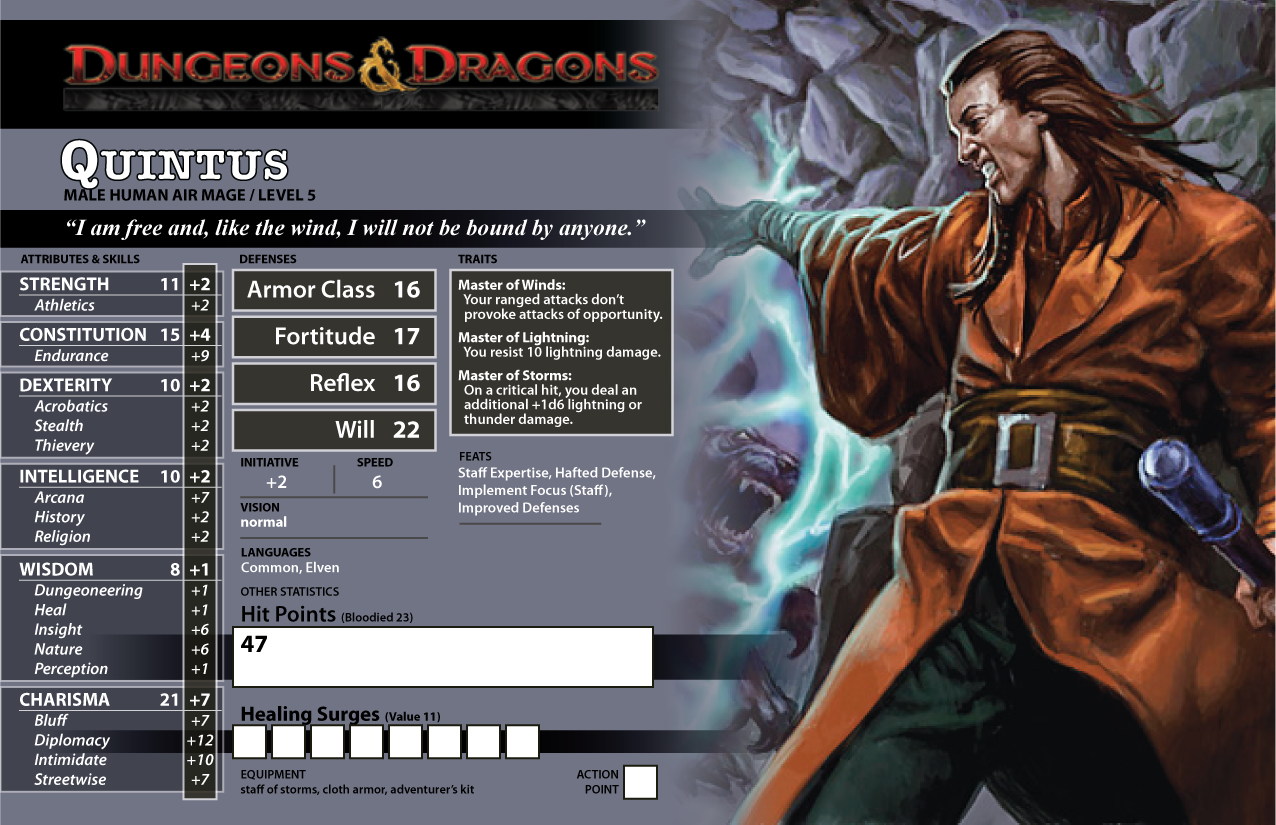
Once I make a character card for a Dungeons & Dragons character, it isn't especially difficult to continue to level it up over time.  That's why I tend to make these as my preferred character sheet.  It's easy to read, has everything I generally need, and looks good.  Furthermore, I can usually print it on one 8.5x11 sheet of paper (if I shrink the overall aspect a little bit).

One of the Dungeons & Dragons games I play in as a player is with a very peculiar yet surprisingly entertaining group of people.  They are great folks but we have the most absurd things happen on a routine basis.  When I had to miss a session, I posted my character on my weblog and sent a link to the DM so whoever filled in for me would have an "easy access" character to use.  The DM liked the format and started asking me to make character cards for other people that could not make it to a session.

My character is a strange one.  In a world dominated by women, where magic is generally forbidden except for those marked by the government, Quintus represents an anomaly.  He is a man and a free air mage.  He wields the power of lightning and storm independent of the rules of law.  As the game progressed, he has been both extremely smooth yet surprisingly naive, even dumb.  Complex situations tend to confused him and he tends to rely on the those that he trusts, the other five people he awoke with on that strange day, memories wiped clean.
Quintus the Air Mage, level 5!
A few new things added to the mix...
Having just reached level 5, this represents Quintus shortly after fighting off a terrible beast (a beholder) and watching one of his only friends, the rather impolite and often abrasive witch Asha, die from a blast of an eyestalk.  His mastery over the powers of storm have grown but the gnawing hole in his soul, his sense of self, has not changed.  Just as he started to decide who he really was, a wander in the company of these strange people he has come to call friend, one of them died horribly.

The strange magician of song, Scarlet, was able to tap some unusual power, ancient forces trapped in the ruins that they found.  When Scarlet returned, she had power unimaginable.  With it, she was able to not only tear the beholder asunder but also tap the very life essence of the world in an effort to bring Asha back.  It is not clear to Quintus what result this will have for him or his "friends."

Tuesday, June 12, 2012

The Elements of a Classy RPG: Rifts

This post is part of a series concerning Class within the context of Role-Playing Games.  For an introduction to the series, see The Elements of a Classy RPG: Introduction.

Although it is not any sort of proper order at all, I want to start with the class system used in the Palladium system.  Palladium Books published a number of different role-playing games, including Heroes Unlimited, Rifts, Ninjas & Superspies, Beyond the Supernatural, After the Bomb, and Palladium Fantasy.  They also had licensed titles such as Teenage Mutant Ninja Turtles and Robotech.  All of them used the same (or similar) game mechanics.  Most of the games used a class system, referring to a character’s class as O.C.C., or Occupational Character Class.  In addition, some games utilized classes based on race instead of occupation, known as R.C.C., or Racial Character Class.  [A few games also utilized P.C.C., or Psychic Character Class, but that designation did not survive to Rifts.]  Eventually, all of this would come together within the Rifts setting, bringing the Palladium Megaverse together in a grim future.  Thus, I want to look at the system as it appeared in Rifts (and its many supplements) in order to get a sense of what the O.C.C. system entailed.

The Juicer, the result of
Nancy Reagan's failure.
The Rifts core rulebook had a wide variety of classes for players to choose from:  Rogue Scholar.  Wilderness Scout.  Cyber Knight.  Crazy.  You chose your class at character creation and that defined the character in mechanics, concept, and story.  It defined what kind of skills your character had, what kind of special features she might have, what kind of money and equipment she would start with, and how she advanced through play.  It also said a lot about where your character came from, how she got her start, and something about her place in the universe.  In a way, the Palladium O.C.C. or R.C.C. defined almost everything about your character (outside of race).  There were not a lot of details to change within any O.C.C. and once you chose it, your character was generally stuck with it.  Occasionally, a character class would allow for a type of major change or “out” from the confines of the class, but such a thing was mechanically rare (i.e., the Juicer O.C.C., a warrior hooked up to a sophisticated drug injection system, could try to break her addiction to the drug treatment, which would result in a longer life span but substantially fewer abilities, leading to a less functional character class).  However, with few exceptions, this type of transition was never explicitly presented within the ruleset.  A player who wanted his or her character to undergo a fundamental life change would likely have to discuss it with the Game Master.

Perhaps "Adventurer" or "Wanderer" would have
sounded more heroic than "Vagabond."
The interesting thing about the Palladium system was that there were a huge number of O.C.C. and R.C.C. choices available.  I even remember seeing Rifts sourcebooks advertising the number and variety of new O.C.C. selections available.  Consider a look at this purported class master list.  On it, you can find Bandit Highwayman, Bandit (Peasant Thug), Reaver Bandit/Raider, Bandit/Pecos Raider, and Vanguard Brawler Thug (a R.C.C.).  Although covering all sorts of Bandits and Thugs, I failed to mention thieves, represented by Gypsy Thief, Gypsy Wizard Thief, and Professional Thief.  In the Palladium universe, there was something different enough about these different types of characters to warrant different classes individual advancement tables and rules.  Sometimes, you would even find an O.C.C. that felt like it was there simply as a joke.  The Vagabond O.C.C., from the Rifts core rulebook, fits an important niche within the greater Rifts universe (that is, everybody who is not something fancy and special) but feels mechanically like half of a class, with less skills, equipment, and abilities than any other class in the book.

The Coalition: Better than you
simply because of the name.
Just by looking over the class system of the Palladium role-playing system, it seems obvious that class is less about mechanical features and more about filling a specified character concept within the greater universe.  It was less the game mechanics that mattered but the place within the overall world that mattered.  In Rifts, it was not enough to have a soldier of the sinister Coalition as a class in the game; the game had some six or seven in the base rulebook alone.  How a Borg differed from a Coalition Borg, or a Psi-Stalker differed from a Coalition Psi-Stalker, was obviously sufficient to warrant individual classes: one was a member of the Coalition military while the other was not.  Granted, there may be particular mechanical differences between the classes, but the fundamental difference rested in its origin.

No, as it ends up, Glitter Boys do
not have special parades every year.
The distinctions between classes sometimes feel almost cheap.  A Glitter Boy O.C.C. has but one identifying feature: it starts with a giant “pre-war” suit of power armor (called a Glitter Boy).  The power armor is its primary class feature.  A Coalition Grunt is not especially different than any other type of bounty hunter, grunt, or mercenary, but the Coalition Grunt is a unique O.C.C. because it represents a character who is (or once was) a member of the Coalition and retains his or her specialized body armor.  Since the classes were so specific in theme and representation, hundreds were available to fill each unique background, story, or character concept.

Considering all of this, Palladium represents a sort of extreme within the RPG system.  Hundreds of classes, each representing a specified niche within the universe.  To make a Coalition Grunt and then insist he was something other than a grunt of the all-mighty Coalition seemed to be missing the point.  You picked Coalition Grunt because your character was a basic soldier within the Coalition military (or, was recently such a soldier).  Although Rifts, like any RPG, promoted the use of your imagination, your character would generally fit within one of the pre-made character molds presented by the creators.  This somewhat unique class system presented a peculiar economic possibility because it allowed the creators to continue to publish new sourcebooks with new classes.  However, as the number of classes continued to soar, the distinctions between classes seemed to decline.  The proliferation of classes ended with very few being especially unique or interesting outside of the role it played within the greater Rifts narrative.

Rogue Scholar: Clearly these books
are full of old beer recipes.
All that being said, the Rifts system was interesting in that it gave you, as a player, a character to play.  It had a sort of “pick-up-and-play” aspect to it.  Pick a Rogue Scientist?  Well, you had a pretty good idea that you were a trained scientist, potentially on the run from the Coalition.  You likely had discovered or created something that the Coalition wanted or you were attempting to devise some technology that would work against the Coalition’s interests.  Rather than ask yourself how your character came to be in the world, Kevin Siembieda provided it in your character’s class description.  This is great for a first time player, but I feel that most players want a little bit more in the production of a character than merely slotting into a pre-existing archetype like Rifts provided.

I suspect very few people are interested in playing a game with a class system as presented in Rifts.  What it accomplishes in providing a character fixed into the greater story has been easily accomplished by other games, both more simply and more effectively.  Instead, the Rifts system ends up becoming nothing more than a horrifying example of bloat within the role-playing world, where the basic ideas of role-playing are pushed aside to get more books on the shelf.  Its few strengths are readily outmatched by the absurdity of its weakness, making a framework few should attempt to emulate.

The Elements of a Classy RPG: Introduction


My class is Wizard. Or Magic-User.
Or Illusionist. Or Enchanter.
Many role-playing games, both tabletop and electronic, have some concept of class to define a player's character.  It has become such an iconic concept that sometimes it appears even when it does not really matter.  However, despite the prevalence of class within the gaming context, the basic notion of class seems to have no definitive meaning.  Many games seem to use it different.  So, in the great adventure that is designing the optimal role-playing game, the question of class is an important one.  What is a class?  What encompasses a character’s class?  Should it be different than a career, or a job?  What about a background or personal history?  These are questions that need to be addressed.

I thought I would start considering how class is treated in different systems and write a thing or two about it.  From there, I hoped to think about what class could mean and, in the context of the new Dungeons & Dragons, what I think it should mean.  That being said, when I began this project, it was intended to be a single article.  Quickly, it grew into two.  From there, I realized that nobody really wants to read a 10,000 word treatise on class and felt it would best be broken up into individual articles.  To begin with, I have decided to examine various games, both tabletop, console, and computer, and look at how they handle the concept of class.  Specifically, I want to look at what the class encompasses, what it means within the context of the game, how much freedom a character has within that class, and what other features exist to further flesh out a character within that system.
Go ahead and guess what class this is...

Why look at all of these different systems?  The hope is to come to an idea of what the concept of class should entail.  A lot of game systems have abandoned the system of class because it is considered far too constraining.  Yet, many games continue to employ a class system because it provides a player with a pre-built archetype with which to interact with the game world.  On the other hand, some game systems try to make very broad, highly encompassing classes intending to capture every possible permutation that of character that could exist.    Although I admit that every rule system is different, the hope is that there is a sort of optimal place for class within a RPG system.  Thus, I go on this journey under the assumption that there are a few basic principles that every game should potentially apply to its class system.  Whether that is true remains to be seen.

Hopefully, this will be a useful adventure.  Although I have read and played a wide variety of game systems, my experience is limited and I hope I can reach all of the relevant different rulesets out there.  If there are particular systems worthy of consideration, I hope that readers will recommend them to me so I can consider them further before I conclude.  In the history of gaming, it is likely that every reasonable idea has been explored by some game at some point, so hopefully I can find them all with a careful examination of the genre.

Tuesday, June 5, 2012

The Gambit of Truth

A few months ago, I was invited to play in a somewhat different Dungeons & Dragons campaign.  All I was told in the beginning was to forget my preconceived notions of how things like race and gender worked with a typical D&D fantasy world.  I would not be creating a character from the onset.  Instead, I was assured that all those details would be provided.  I tentatively agreed, not knowing what I may have gotten myself into.

The setting had a vaguely Roman feel.  The character awoke in a strange place, surrounded by signs that indicating that they had been involved in a mysterious ritual.  Nobody could remember anything about who they had been or any relevant facts about the world.  From the initial confusion, I discovered that I was a master of air magic, specializing in lightning.  My character, as of yet unnamed, was a Storm Sorcerer.  He could wield the power of lightning to destroy his foes.  The rest of the group was a motley crew of strange folk, most of whom were made even stranger by the lack of context regarding race and gender.

It took a number of sessions, maybe three or four, for me to even name this rather strange character I had discovered.  At that time, the newly named Quintus also underwent a transformation, becoming the newly released Air Elementalist instead of a Storm Sorcerer.  The Elementalist was new and I was interested in giving it a crack.  Besides, I felt like the Storm Sorcerer was not quite my class.  From that, Quintus the Air Mage was finally born.

I am the Master of Wind and Lightning is my servant!
The Elementalist: Simple yet Effective.
Quintus is another of my personal D&D character cards.  He is level 4, although I did not check Inherent Bonuses as we do not play with them in this campaign.  Two of his abilities, Air Bending and Elemental Feedback, are actually item powers.  However, as the current 4E rules do not bind item power usage per "milestone" anymore, I thought it would be more interesting to represent those powers as his own innate abilities instead of item abilities.

Tuesday, May 8, 2012

Design Thoughts: Beyond Good and Evil


It's a good tonic, altruism.  Nothing
helps one put problems in perspective
like allegiance to a higher cause.
First, I would like to preface this by saying this does not intend to be nearly as big-headed as the title may suggest.  It is not my intent to rewrite the works of Friedrich Nietzsche or even discuss them.  This is centered completely on the place of good and evil within the context of Dungeons & Dragons.  It comes up a lot in the discussions of the next iteration of Dungeons & Dragons and also in a lot of classic D&D debates.

It has been made public that the next iteration of Dungeons & Dragons will see a return to the nine-point alignment system.  Most importantly, the spectrum of good and evil first introduced in Advanced Dungeons & Dragons (1977) would see a return.  This has left me somewhat frustrated, mostly because I have never been able to rationalize how an objective conceptualization of good and evil could ever fit into the framework of a fantasy world like Dungeons & Dragons.

Who else would kick a man for
eating ice cream?
I want to focus this on the place of the gods within the construction of objective good and evil.  There are many gods within any D&D pantheon that are labeled as some sort of Good.  In fact, most settings have a host of good gods, whether they be Lawful Good, Neutral Good, or Chaotic Good.  Yet every good god has some different folio, some different set of goals and interests.  When people talk about what it means to be good within the setting, I cannot help but wonder where that definition is supposed to come from.  Normally, I would expect the gods to aid in the definition of good and evil, but D&D deities have taught me to think otherwise.

At the end of the day, it is quite easy to end up with two gods of good conflicting over some major issue.  So often, it seems that two definitionally good gods disagree over some sort of major issue with ethical ramifications.  My question, then, is: Which choice is the good?  Which good god do I follow to assure that I am following the good choice?  If I support Tyr's pursuit of justice, am I acting in conflict with Ilmater's pursuit of mercy?  Is there no "good" option, or does that fall under a different god's folio?  How do I know, as a character in the fantasy world, what good really is?
I think I'm starting to sound more like
Moriarty than Sherlock Holmes.

I do not want to sound like the guy that is trying to shut down on everybody's notion of good in the fantasy world.  I feel like objective good has a place within a monotheism if the one god is a god of good.  But when gods have folios composed of arts, crafts, or abstract ideas like vengeance and strategy, it is difficult to see where good falls.  Honestly, it is the same issue I have when popular video games try to integrate notions of good and evil into the narrative.  Sometimes, I do something that seems pretty good and I get an evil point.  Or, in the reverse, I do something that feels pretty evil but get good credit for it.  Very rarely do these games go out of their way to tell you what is meant by good.  It is only by guessing can you intuit what the scenario developer really meant when he or she used the word "good" within the game.

(Note:  All of the images on this post were taken from the Batman Alignment Chart)

Sunday, April 29, 2012

On Playing D&D


Recently, somebody told me that I clearly just play Dungeons & Dragons wrong.  It was something of a peculiar experience, since so much of the discussion recently has been "How you play D&D is the right way."  To have somebody so handedly dismiss me and my idea of the game was disturbing, to say the least, insomuch that it left me rattled for at least a day and I considered canceling all of my D&D games in response.  For whatever reason, I took it very seriously.

In resolving the issue, I had to spend a lot of time thinking about why my D&D experience was different than the apparent norm.  My experience with D&D, and tabletop role-playing, followed a slightly different course from some but I do not think it was such as to be considered "wrong."  I thought it would be appropriate to write a little bit about it here to provide some prospective.

Red Box Awesome!
I picked up my first D&D set, the Red Box Basic Set, in 1988, shortly after moving away from Los Angeles.  At the time, I was eight years old.  I was familiar with the idea of D&D as some family friends in Los Angeles played AD&D every now and then and I got to watch.  I knew what the idea was but I never got to play.  Now, armed with my own set, I could build the kinds of adventures and whatnot that I had seen and heard of from my friends and older brother.  Or, so goes the plan.

Years passed without me ever finding a group to play with.  I had kept up, getting books and sets here and there, even exploring the bowels of AD&D 2nd Edition.  My brother got involved with a group in high school and I would hear exciting tales of his games.  It was not until late 1992 or early 1993 that I finally cobbled together a group of people to play with.  For five years, all I could do was read and hear about how great a game this was without ever getting a real chance to play.

Gargoyles. They look evil.
Why is any of this relevant to how I learned to play D&D?  It is important because before I ever really played D&D, my perspective had already been colored.  From 1987 to 1991, I spent a fair amount of time playing the Ultima series on my home computer.  By the time I played Dungeons & Dragons, I already had fixed ideas about what a role-playing game would entail.  Most significantly, Ultima IV, V, and VI had impressed upon me the idea of what a fantasy world would be.

As to how this relates to the idea of me playing D&D wrong relates to the notion of monsters, alignment, and sentience.  By the time I played D&D for the first time, Ultima had already affected my perspective.  Ultima VI: The False Prophet taught me the importance of considering and understanding alternative perspectives.  The gargoyles, who appear to be a race of monstrous humanoids at first glance, are a legitimate race of sentient creatures with just as meaningful a claim on survival as humans.

Only evil monsters sacrifice the Avatar, right?
The gargoyles of Ultima VI are monsters when you begin the game, pure and simple.  They are Chaotic Evil (or, perhaps, Lawful Evil) monsters that seize holy sites across the world and kill people with reckless abandon.  They even try to sacrifice you in the introduction sequence.  As you play, you soon determine that these monsters are in fact civilized and have a developed culture.  However, they see you as the ruthless monster.  You, the hero, tore into their world, stripped them of their holiest artifact, and left their world to deteriorate slowly into nothing.  In D&D terms, you were the Chaotic Evil champion and humans were nothing more than monsters to kill or be killed by.  The importance of understanding perspective was huge in completing the game.  By the end, you have created a world where humans and gargoyles must work together to share in the wisdom of the holiest artifact (the aptly named Codex of Ultimate Wisdom).
But Meepo is friend!

When I finally got to playing D&D, the lessons of "The False Prophet" still resonated.  Goblins, orcs, and the rest of the intelligent races of D&D Land had just as valid a claim to civilization as any other.  So, when I read that a monstrous race was "always Evil," it bothered me.  It seemed very small minded, very ignorant to assume that a race was "always Evil."  The idea that Goblins or Kobolds were something you killed on sight, not because they attacked you first but because they're an evil race, did not correlate with my worldview.  I could not help but try to rationalize it in a modern view: "Yeah, we kill those goddamned <your_least_favorite_race_or_nationality> because they're evil!"  It did not settle well with me.  It bothered me that people would want a fantasy setting where killing people because of their race was acceptable (or, to a certain extent, desirable).

This... is... D&D!
So how am I playing D&D wrong?  Because goblins and orcs are there to be killed.  They are an evil race and they are there to be defeated.  That is how D&D has always been.  To try and apply big-headed philosophical notions of good and evil to a game about exploring dungeons, killing monsters, and getting treasure is just ridiculous.  In short, D&D has always been the original Munchkin.  It is nothing other than that.  To play it otherwise, in the opinion of this person I spoke to, was to play it wrong.

Obviously, after some consideration, this opinion is neither true nor universally held.  If Eberron taught us anything, it's that a D&D game can be complex, interesting, and morally ambiguous while still fitting within the framework of Dungeons & Dragons.  D&D did not have to be the mindless hack-and-slash and treasure-gathering that Gary Gygax's original adventures back in the late 1970s and early 1980s seemed to be.  Although Dungeons & Dragons may have its roots in a tactical combat game that developed into an adventuring game, the modern D&D has become much more than its progenitor.  But it does not have to be, if the group wants it to be simple.  Really, it's the game you want it to be (as long as you want a primary method of conflict resolution to involve violence).

I acknowledge that D&D started within a certain framework.  I also acknowledge that every group, every player, shapes the game into the game they want to play.  For me, it was complex.  It was ambiguous.  "Good" and "Evil" are relative terms and practically meaningless.  Goblins and orcs held just as valid a title to life and society as elves and dwarves.  This is how I play and this is how I continue to play.  The words of one close-minded player will not change that.

Tuesday, April 3, 2012

On Character Skinning: From Lounge Lizards to Sith Lords, and everything in between.

Some people, when they finish laughing at the absurdity of my custom character cards, ask why I bother.  That is a fair question but I want to respond with a side story.

In an Eberron game I am playing in, we recently added a player who will be playing a previously prominent NPC leading us on an adventure. A wealthy Lord, the DM made the character as a bard as he thought that captured the feel he was looking for. The player of this character had something to say about that, though...

"Song of Rest? No. I'm renaming that.  I call it '...the Sooner You'll Get Paid.'"

So, after a single session, the iconic image of a bard singing melodies of healing suddenly became an impatient nobleman prodding his hirelings to expedite the mission.  As he continued crossing out other power and feature  names only to replace them with more appropriate alternatives, the very nature of the character changed. He was no longer a bard. He did not sing or have an instrument. He was a cunning leader who knew the power of proper motivation.

And it's awesome.

That is the type of re-characterization that D&D4E can lead to. I think this is important to the game as it lets you take the mechanical trappings that the rules give you and make it the character you want.  With a little thought, any variety of ridiculous character can be created.
Now I understand tactical history!
  • Armchair tactician with a giant history book that he uses to defend himself? Lazy Warlord with a Warhammer & Shield (conceptualized as a single item).
  • Street Fighter's Dhalsim, a yoga master who shoots fire from his mouth? Pyromancer Mage.
  • Red Alert 2's Yuri, a mysterious psychic master with the ability to crush people with a thought? A psion.
I stopped playing AD&D back in the 1990s because I found the class system especially limiting. I felt you were pigeon-holed into what they thought you should be. A fighter fights and does little else. That never seemed fun.  I moved on to systems like GURPS, where I could make the character I wanted (and have to live with the consequences).  Now that I'm older, I realized that the D&D system can be flexible as you want it to be. You just have to be a little creative.

So, that is a good explanation for why I do this. Granted, the original motivation was to provide a series of alternative characters for D&D Encounters since Wizards of the Coast stopped providing new ones. However, it has become more of an expression of what the system really is capable of with the right thought process.

So, for those playing at a D&D Encounters game, I hope you use the novelty characters I have provided and enjoy the experience.  The sinister Sabrak dwarves of the Sunset Mountains, the vile Feywild hag Soryth, or the Lost Heir of Neverwinter will never expect Dhalsim, Link, and Leisure Suit Larry to stop them.

As an addendum, the art on this page was taken from the DeviantArt site for njay, njay.deviantart.com.  It has been used without permission but consistent with 17 U.S.C. 107 (Fair use).

Monday, December 5, 2011

Stylizing your D&D4E Character

One complaint I hear a lot about D&D 4E is that it does not allow for a great deal of role-playing, at least as compared to it's immediate predecessor.  There are a number of specific examples worth exploring, but I wanted to explore something that developed at my D&D Encounters table over the past year.  Sometimes, it's the style and polish, the quirky character customization, that differentiates your dwarf fighter from every other dwarf fighter out there.

I started playing Fourth Edition after hearing the Penny Arcade D&D podcast.  One thing I still remember from that podcast was Mike Krahulik renaming one of Jim Darkmagic's power,  Magic Missile, to "Jim's Magic Missile" and that this kind of personalization was actually highly promoted by the WotC Dungeon Master.  Shortly thereafter, I played in a game where somebody made a shifter tempest fighter named Wolverine who wielded two katars in battle. In both cases, the player made essentially cosmetic choices that helped solidify the character as a *character* and not just a monster killing robot. I have spent a lot of time thinking about this notion of making something your own as I DM games both public and private.

One day, a friend brought a half-orc monk character he made to my Wednesday D&D Encounters.  Afterward, with help from a friend, I considered how hard it would be to make Akuma (of Street Fighter fame) into a D&D monk character.  We started testing various builds and eventually came up with a few options that seemed to fit very well.  We made a novelty character card for him, renaming all of powers and abilities to be sound like Street Fighter moves.  It worked surprisingly well.  Akuma made a number of appearances in the Dark Legacy of Evard, exploring the Shadowfell and vanquishing enemies with his Tatsumaki Zankukyaku.

Eventually, making notable video game characters into D&D characters for Encounters became a thing I do.  People get to experience Neverwinter or the Feywild with characters like Zero (Mega Man X), Starkiller (Star Wars: The Force Unleashed), Naked Snake (Metal Gear Solid 3: Snake Eater), or Larry Laffer (Leisure Suit Larry).  They play like you would expect.   Zero slashes monsters with his Z-Sabre.  Naked Snake hides in the shadows and chokes enemies by surprise.

So, back to my original question.  Does Fourth Edition promote less role-playing than Third Edition?  Like any role-playing game, you get out what you put into it. The rules of the game should not change your ability to create a character in a fantasy world and have them go out on adventure. I think an important element is the ability to customize the details about a character outside of the realm of game mechanics. That process goes a long way to making the game more about role-playing.