Tuesday, July 3, 2012

Dungeons & Dragons: Ace Attorney (Part 1) [Alternate Image]

Alternate Image?  It's something I picked up from local game company Flying Frog Productions.  As it ends up, they are not fond of doing special promo cards at trade shows or for pre-orders.  Instead, they like to do alternative images on normal cards.  It makes them unique but not game-changing.

After I did Apollo Justice and a related upcoming card, I thought it appropriate to redo the art on the Miles Edgeworth character card so it matched the style of the other ones.  Hope people like a "matched set" of characters.

Same text as before, new image (mostly with new background)
Still the same Sorcerer-King Warlock we already saw.

Monday, July 2, 2012

Dungeons & Dragons: Ace Attorney (Part 2)

Last week, I finally got around to creating a character from Phoenix Wright: Ace Attorney as a Dungeons & Dragons: Encounters character.  Inspired by my work, I continued crafting characters out of that same framework.  Although practically every character in that game does not fit within the fantasy framework, I found it easier and easier to jam certain characters into certain roles.  Honestly, the further I went it, the more I realized that if they could fit Phoenix Wright into Ultimate Marvel Vs. Capcom 3, I could fit Phoenix Wright (and friends) into Dungeons & Dragons.

Miles Edgeworth had been a character I had thought about for quite some time.  It only seemed natural for the "Devil Prosecutor" to be a warlock.  It was only a matter of tweaking the pact powers and abilities until I got something that I liked.  Moving on, I felt that the Fey Pact Binder had some utility for adaptation into a Phoenix Wright character as it had the close blast and burst powers that seemed to fit right.  As I already had plans for Phoenix Wright, I tried to think about what other important character would fit this model.  From there, it began to come together.
Phoenix Wright's protégé, Apollo Justice.
Without the Warlock's Curse, there's a lot less going on.
Apollo Justice is an Eladrin Fey Pact Warlock (Binder).  It was a strange thing when the fourth game in the Ace Attorney series involved a completely different character.  Beyond that, Apollo Justice: Ace Attorney seemed a bit strange, as it featured some of the characters and game concepts introduced in the Nintendo DS only "bonus" level from the first game while introducing a new host of characters and nonsense.  Apollo himself was a different attorney than Phoenix Wright (who, by this point, had been disbarred).  One of the new gameplay elements was the ability to "observe" people as they testified, finding that little feature or twitch that gave away the fact that they were hiding something.  Truth be told, it was aggravating as hell.

All of this felt like it worked, just a bit, into the Fey Pact Binder.  His At-Will attacks fit nicely into the iconic "Objection" and "Hold It" maneuvers of the game while his Encounter power was torqued to feel like Apollo's iconic "Gotcha" mode.  Some of the other abilities and powers required some thought, but this became easy to do once I actually remembered Apollo's story and how he fits within the greater Phoenix Wright universe.

*** MILD SPOILER AHEAD ***

Nonetheless, Apollo was worth conversion in the Dungeons & Dragons model because his mystical bloodline fit well with some of the things that felt otherwise un-lawyerly.  As a decedent of the great magician Magnifi Gramarye, magic was part of his thing.  Rolling him in with the rest of the family of magicians seemed appropriate for his more ridiculous powers, such as the Eladrin Fey Step.  As I proceeded to build other characters from this game, it worked even better as another character could also share in the "Gramarye Bloodline" in a similar way.

*** END SPOILER ***

Hopefully, Apollo Justice can bring something new and interesting your Dungeons & Dragons: Encounters sessions.  He is ridiculous, absurd, but most importantly he is all Essentials.  He should be relatively simple for new players to get into and have fun playing.

Friday, June 29, 2012

Please Pay All Late Fees In Advance. (PWA 2.2)

Phantasy Warrior Advance: Please Pay All Late Fees In Advance
This goes back to my original application to take the LSAT, but it's true of just about everything nowadays.  I feel like the idea of the late fee to apply for something must have been conceived of one day by some guy.  Other people heard about it and thought, "Oh, crap!  That's a great idea!"  Pretty soon, everybody is doing it, often for things that do not even matter.

More frustrating than the late fee, though, is the ridiculous idea of itemized "fees."  I often see applications that have five or six itemized fees, singled out one by one as if somehow it made them more palatable when delivered in pieces.  The worst is when you see an "application fee" but then you see three or four more fees that sound like they should clearly be part of the application process but somehow warrant separate billing.  "Processing fee" is my favorite.  Did you intend to accept the application but not process it, hence the need for a separate processing fee?  It never made sense to me.

Unfortunately, it's pervasive.  Everybody seems to do this nowadays.  I guess there is no use fighting it.  Of course, if you are a young would-be hero, what do you do if you cannot afford to pay?  We will see...

Thursday, June 28, 2012

Dungeons & Dragons: Ace Attorney (Part 1)

As a gamer of many stripes, I have played a lot of different games.  I have been doing so for the better part of thirty years.  As I have been creating characters for Dungeons & Dragons: Encounters, I have tried to think of iconic, interesting, or just damn awesome figures from games that deserve representation within the framework.  Sometimes, I come up with one, like Leisure Suit Larry, and I find a way to work it into the D&D framework in a way that seems to fit.  In other situations, I sit for months trying to find a way to get it to work, often to no avail.  Occasionally, though, months and months of sitting manifests in ways I never would have imagined.

I started playing Phoenix Wright: Ace Attorney before going to law school.  I used to always insist that I was "training" for my big days as a lofty attorney.  I would never have believed that somebody could make a classic adventure game out of comical parody courtroom drama, but they did.  The characters were ridiculous, entertaining, and all around awesome.  As I fell knee deep into Dungeons & Dragons character development, I felt like I wanted to find a way to capture some of those characters into the D&D game.

The challenge proved harder than I anticipated.  Making Phoenix Wright proved more difficult than I had imagined.  What I wanted was some sort of psychic, ranged defender.  I wanted to find a character that felt like he did what Phoenix Wright did so the re-skinning would be simple.  After months of struggle, I gave up.  But, in that time, something else came to mind.  There was a character, easily captured within the game rules, that I could make.  From that, I began to work.

The fabled "Devil Prosecutor," Miles Edgeworth.
Former student of Manfred von Karma...
When I thought "Miles Edgeworth," I immediately went to "Infernal Pact Warlock."  After a little look at that, I thought that I could do better.  I wanted something that would feel like it came out of the game.  Setting people on fire did not capture the Miles Edgeworth I had hoped for.  As I flipped through the Warlock options, though, I came across the Dark Pact and the Sorcerer-King Pact, both options that could be easily adapted to serve as my favorite prosecutor.  [Author's Note: I did spend two years working at a prosecutor's office and, although I do adore the character Miles Edgeworth, I actually seriously question his effectiveness as a prosecutor.]  After toying with both, the Sorcerer-King Pact seemed like a simpler option for new players and an easier way to capture it into the "Edgeworth" character.

Warlock aficionados will likely detect that I have broken up the Warlock's Curse power into *four* different abilities on the card.  Honestly, that was done to make the Warlock's Curse power more digestible for new players.  It is a huge block of text that is quite confusing for players new and old.  In this format, I had hoped to present it in a way that was functional and easy to understand.  Of course, as I had chosen the Sorcerer-King Pact, I had to introduce a way to track "fell might."  It did not take long to develop and system, though, and from that Miles Edgeworth was born into the world of Dungeons & Dragons.

[Note: I posted an "alternate image" version that matches better with the other Ace Attorney characters presented on this blog.]

Wednesday, June 27, 2012

The Gambit of Truth (Part 2)

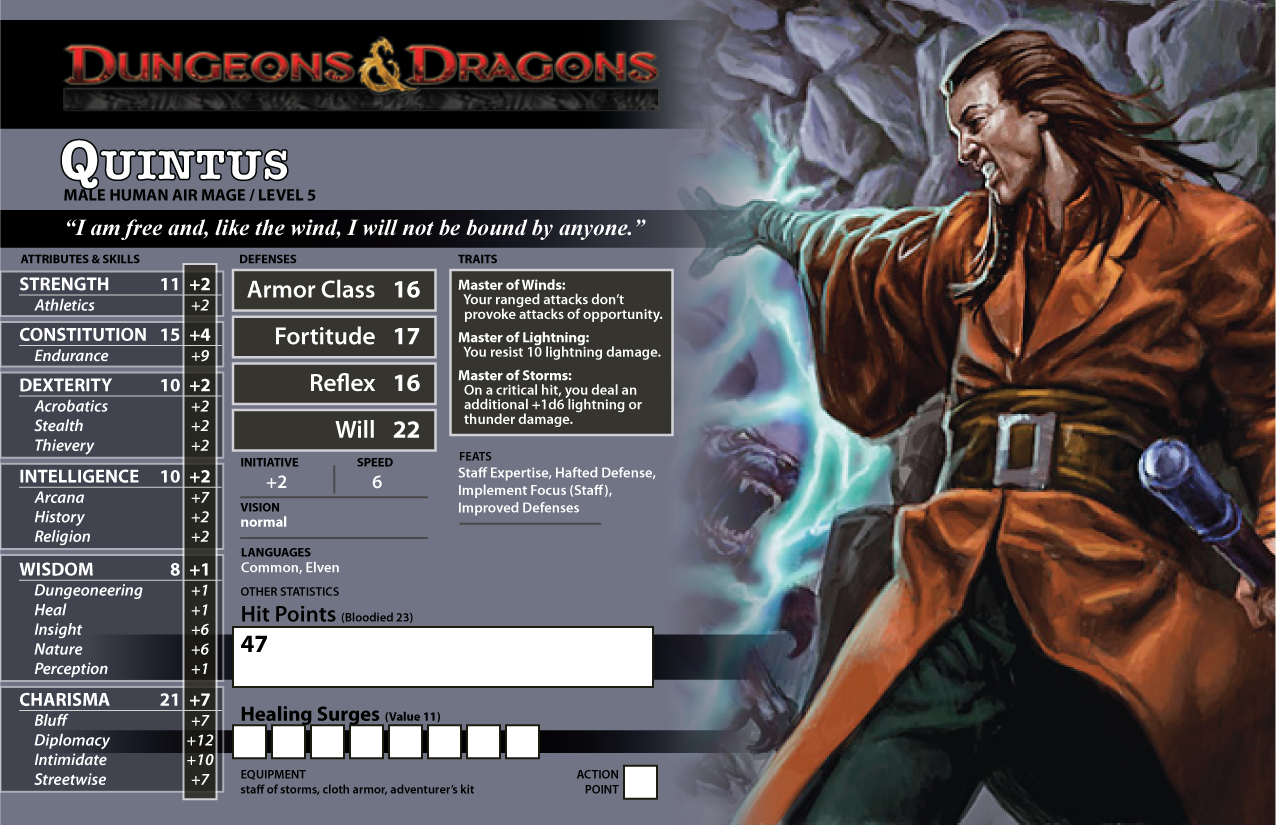
Once I make a character card for a Dungeons & Dragons character, it isn't especially difficult to continue to level it up over time.  That's why I tend to make these as my preferred character sheet.  It's easy to read, has everything I generally need, and looks good.  Furthermore, I can usually print it on one 8.5x11 sheet of paper (if I shrink the overall aspect a little bit).

One of the Dungeons & Dragons games I play in as a player is with a very peculiar yet surprisingly entertaining group of people.  They are great folks but we have the most absurd things happen on a routine basis.  When I had to miss a session, I posted my character on my weblog and sent a link to the DM so whoever filled in for me would have an "easy access" character to use.  The DM liked the format and started asking me to make character cards for other people that could not make it to a session.

My character is a strange one.  In a world dominated by women, where magic is generally forbidden except for those marked by the government, Quintus represents an anomaly.  He is a man and a free air mage.  He wields the power of lightning and storm independent of the rules of law.  As the game progressed, he has been both extremely smooth yet surprisingly naive, even dumb.  Complex situations tend to confused him and he tends to rely on the those that he trusts, the other five people he awoke with on that strange day, memories wiped clean.
Quintus the Air Mage, level 5!
A few new things added to the mix...
Having just reached level 5, this represents Quintus shortly after fighting off a terrible beast (a beholder) and watching one of his only friends, the rather impolite and often abrasive witch Asha, die from a blast of an eyestalk.  His mastery over the powers of storm have grown but the gnawing hole in his soul, his sense of self, has not changed.  Just as he started to decide who he really was, a wander in the company of these strange people he has come to call friend, one of them died horribly.

The strange magician of song, Scarlet, was able to tap some unusual power, ancient forces trapped in the ruins that they found.  When Scarlet returned, she had power unimaginable.  With it, she was able to not only tear the beholder asunder but also tap the very life essence of the world in an effort to bring Asha back.  It is not clear to Quintus what result this will have for him or his "friends."

Tuesday, June 26, 2012

The Elements of a Classy RPG: Dungeons & Dragons (BECMI)

This post is part of a series concerning Class within the context of Role-Playing Games.  For an introduction to the series, see The Elements of a Classy RPG: Introduction.
Dungeons & Dragons:
Basic Set (1977-1983)

Dungeons & Dragons has a strange history.  Although the game first appeared in 1974, written by Gary Gygax and Dave Arneson, would eventually be divided in 1977 into two different games: Dungeons & Dragons and Advanced Dungeons & Dragons.  The “basic” form of the game would eventually be released from 1977 to 1986 in several boxed sets with multiple revisions, labeled as Basic (Red Box), Expert (Blue Box), Companion (Green Box), Master (Black Box), and Immortal (White) sets.  These would eventually be compiled into the Rules Cyclopedia in 1991, corresponding with several mass market items, including the “Big Black Box” and its progeny.  The interesting consideration is that for nearly two decades, Dungeons & Dragons had two distinct forms with contradicting rulesets and approaches to play.

My first Dungeons & Dragons set was the BECMI Basic Set, a system of sometimes questionable acceptance in the greater D&D world. I really liked it at the time and I thought it was a great way to learn about the game. The rulebook had a solo adventure to show you how things worked and it provided content to unleash upon your unwitting friends. To this day, I rarely see role-playing game products that introduce players to the game quite like the old Red Box did. There is something about thrusting a potential player right into it through a solo adventure that so many games fail to do. When they created a new mass market product, the “Big Black Box,” they made an even bolder attempt at the solo adventure concept.  It used a map, paper stand-up characters, and an involved packet of tabbed pages.  However, outside of those products, I did not see that kind of introduction to a role-playing game until the new D&D Essentials Red Box and the Pathfinder Beginner Box.  What sets the old Red Box apart for the discussion here was the way that edition of Dungeons & Dragons approached the concept of class.

The "Big Black Box" of the early 1990s.
Out of the box, the base game had seven classes.  Character creation was an extremely simple affair.  Although the game lists twelve steps, that may be something of an exaggeration.  [Note: This twelve step process was taken from the 1991 TSR publication D&D Rules Cyclopedia.]  Step 1: Roll for ability scores. Step 2: Choose a character class.  Step 3: Adjust ability scores (lowering some to raise your “prime requisite”).  Step 4-6: Roll for hit points and money, buy equipment.  Step 7-8: Computer other relevant numerical data (saving throws, ability score bonuses, etc).  Step 9-11: Choose alignment, name, height, weight, and other “background” elements.  Step 12: Earn experience (seriously a step of “character creation”).  The whole process probably took less than 15 minutes.  The only real choices involved in making your character that had mechanical result were rolling ability scores and choosing a class, with the potential option for tweaking ability scores to better prepare your adventurer.  So, class was an extremely big deal in this edition as it said mostly everything about your character.

This guy is a Fighter.
The four Human classes ran the standard D&D range of “core” classes: Fighter, Thief, Magic-User, and Cleric.  If you picked a Fighter, your character was a Human Fighter.  There were no Elf or Dwarf fighters in this edition of Dungeons & Dragons.  The same was true of the other three core classes.  However, the class you chose said a lot about who your character was and how he interacted with the world.  Did he wield the powers of magic?  Did she invoke the gods?  Could he sneak about, undetected by others, and gain access to locked and trapped spaces?  Honestly, given the few choices you had in character creation, your class said more about who your character was than any other choice you made.  There were no subtle distinctions and no real variants.  This Dungeons & Dragons had no Paladins, no Rangers, no Wardens, no Duelists, no Barbarians, and no other sorts of nonsense (at least not as a basic class choice).  This was Original Dungeons & Dragons.  You picked one of four classes and you filled in the rest on your own.

What do you mean Halfling is
a "class" in this edition?
One peculiarity of this system was the presence of three demihuman classes.  To play an Elf or Dwarf in Dungeons & Dragons, you chose that as your class.  They occupied a space somewhat different than the Human classes.  The Elf was a sort of Wizard/Fighter, allowing strengths of both classes to shine.  The Dwarf felt like a Fighter but with unique traits or characteristics unique to a non-human race.  The Halfling felt like a very different kind of special fighter, acquiring different abilities that made him more capable in woodland settings.  By the Expert Set, they had a different advancement system and very different rules, but in the short term they felt a lot like unique or interesting variants on the standard Human classes.  All around, the idea that the fantasy races were described using class felt like a really peculiar choice but it worked in the context of making a game easily approachable by new players.  That said, it did result in one peculiar element: all Elf, Dwarf, or Halfling adventurers were very similar to one another, potentially even exactly the same.  An astute player may wonder: what about Dwarven Priests or Elven Thieves?  As far as player characters were concerned, there was no such thing.

Hey!  These guys are Fighters, too.
This way Dungeons & Dragons handled class is interesting when compared to other games.  Your class says everything about you character mechanically.  It says a lot about his place within the world yet it leaves a great deal of room for you to fill in the blanks.  Was your Fighter a brave, stalwart knight, clad in the shiniest armor in the realm?  Perhaps your Fighter was a dueling swashbuckler, fighting off enemies with a deft blade and clever wit.  Maybe that Fighter was a wild tribesman from the Far North, clad in hide and swinging a mighty axe at his foes.  They were all Fighters and, to that extent, all the same.  Yet, by not saying much about the character, it did allow you, as the player, an opportunity to fill it in as you thought relevant.  It just so happened that any choices you made about your character would not mechanically impact your character unless your Dungeon Master wanted them to (and made up some rule to provide for it).
The Druid, relegated to
level 9 Cleric upgrade.

At later levels, the core classes began to see some variety in the options available.  Fighters could choose to become Paladins, Avengers, or Knights.  Clerics could choose to become a Druid.  Wizards and Thieves would have to choose whether to become free agents or lords.  Although available, these options to further customize your class were few and far between.  In fact, most characters would have roughly one or two choices to make throughout the adventuring career.  They usually amounted to choosing between a traveling lifestyle or that of a landed ruler.  Would you have a stronghold or would you become an agent of an existing lord, guild, or priesthood?  With all that being said, the mechanical elements were light compared to later editions of the game.  It made character advancement simple but not terribly enthralling.

It seems very strange to look back on so definitive a game and realize that it did not provide a great deal of options for players with respect to character advancement.  A player could make two Fighters, creating one as a fur-clad barbarian with axe and the other a dashing swashbuckler with rapier, and both would function identically outside of their randomly rolled ability scores and weapon choice.  Maybe this dearth of features or options are why an Advanced version of Dungeons & Dragons felt so necessary for some players.  Perhaps this fundamental lack of options, features, or interesting things to meddle with is why so many people who played the game began making up their own rules.  Class provided you only the most limited framework with which to build a character.  It was up to you, be it player or Dungeon Master, to fill in the interesting details.  Maybe wearing lighter armor gave your swashbuckler a bonus in a way that an armor-clad knight would not have.  Maybe your group felt the need to create your own classes to fill the holes.  Nonetheless, I cannot help but feel like it would have been nice if the game gave players something to make each character feel unique from another character of the same class.
Madness? No, this is Dungeons & Dragons!!!
It is a strange thing to look back at a game system I loved so much as a youth and find that it no longer feels welcome amongst my stable of interesting role-playing games.  It had its interesting points, to be sure, but that old systems sits in a weird place in the modern game world: it is too complicated and fussy to fit in with modern story games but wholly unsophisticated (complicated?) enough when compared to modern tabletop RPGs.  The game’s use of a class system is so encompassing yet so fundamentally uninteresting as to give a player like me pause.  Unlike a game like Rifts, this original Dungeons & Dragons does not supplement its simple class options with a vast range of selectable classes nor does it allow the mixing of different classes in unique ways like Final Fantasy.  The class system presented here, outside of its bare simplicity, does not bring much to the table when it comes to looking at class within a RPG.  As it stands, this Dungeons & Dragons serves best as a gateway game, introducing players to the concept and then quickly turning them to more sophisticated options.

Monday, June 25, 2012

D&D: The Clone Wars (Part 7)

It is an interesting thing, trying to build specific characters using the mechanical structures of Dungeons & Dragons Fourth Edition. Some characters are extremely easy to build, at least in a basic form. The Star Wars: The Clone Wars animated series has provided quite a stable of adaptable characters. Jedi are generally "some class with a sword" and adapted to fit the style and flavor of a particular character.  The clone troopers have all fallen under a somewhat similar category, being "class with bow/crossbow" and adapted to that end.  Some, on the other hand, are more complicated.  Occasionally, strange character warrant strange mechanics, such as C-3PO as the "lazy Warlord" build.

In some cases, it is just terribly difficult to find something that fits the exact way I feel the character should.  Captain Rex quickly became one of those characters.  He should be simple enough: a clone trooper with two hand blasters.  However, no class within the Fourth Edition framework quite captured this especially well.  I had already done "guy with a handgun" with Resident's Evil's Barry Burton: an Essentials Thief armed with a Hand Crossbow.  My first idea was to replicate that character for Rex but I quickly found that it did not feel right. Eventually, frustration would lead me to examine the Seeker, a generally maligned and ignored class from Player's Handbook 3.  One variant of the Seeker utilized throwing weapons and several of the powers had "Melee or Ranged" capabilities.  After some thought, this seemed like exactly the thing for Captain Rex.  He can fight at range but he does his best work at melee and short range.  That got me started.

The Seeker ended up being a bit more difficult than I would have originally imagined. Despite having throwing weapon powers, the "out of the box" Seeker only has two throwing weapon proficiencies: javelin and dagger.  [Technical Note: The Seeker also has proficiency with a few odd throwing weapons added in later supplements, including the widow's knife and short spear, but I did not count those.]  Neither was especially enthralling of a choice.  I wanted something that could be used one handed but that could be used in a pair, like Rex's Hand Blasters.  I originally considered the Hand Axe or Throwing Hammer, both reasonable choices, but I found taking two weapons did not actually gain anything.  I flirted with a few exotic Dark Sun weapons, but eventually something came to mind: the Net.

Anakin's dependable clone commander, Captain Rex.
Rex is heavy on close-range monster control.
In my research of using Nets, another feat path came up: the Foamgather Heritage feats.  Foamgather Warrior, gave a +1 (untyped) bonus to attacks made with a net.  In addition, it granted use of a special Melee or Ranged net attack which could grab (immobilize) and reposition enemies.  This seemed like a really good choice for Captain Rex, as well.  Not able to decide between the two, I decide to go with both sets of feats (Net Training and the Foamgather feats).Way back in the early days of Fourth Edition (October 2008!), Dragon magazine featured an article on gladiators and gladiatorial combat.  In it, they introduced rules for "iconic" gladiatorial weapons, including Nets, Whips, and Bolas.  As these weapons were all somewhat exotic and generally only powerful within the context of special abilities, they included multi-class paths for gaining proficiency, special abilities, and new powers with specific weapons.  The basic net feat, Net Training, grants proficiency with the Net and the special ability to slow targets with each blow.  That seemed an interesting choice, so I went with it.

As it ends up, this is a character for which a few more levels would yield interesting results.  The two additional feats that would help improve Rex's performance are Flail Expertise, which would give an additional +1 to hit with the next and allow him to prone targets instead of slide them, and Far Throw, which would increase his Ranged capabilities from 2/5 to 4/7.  Honestly, the only concern at that point would be his armor, as he would rely on being "in the mix" to get his controlling done but be susceptible to attack.  Perhaps all he needs is a good defender, like Jedi Knight Anakin Skywalker...